Introduction about Agroha & Maharaja Agrasen
Agroha (Agra or Agr) Republic was established around 51 years before the war of Mahabharata. According to the writers of “Bhavishya Puran; KeAgravansh” “Vanishanukirtnam” and “Uru Charitam” Maharaja Agrasen ruled about 5000 years back over Agroha around the time of Mahabharata.
In order to live in heaven after death, we shall have to live in heaven before death” avowed Maharaja Agrasen, a king of great administrative skill. His concepts of kingdom and the duties of the king towards his subjects evolved him as a centurial man. Equality, Nationalism, Socialism and Non-Violence were the principles which formed the backbone of his kingship.
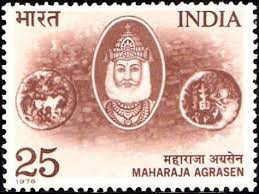
The Government of India issued a postage stamp in honour of Maharaja Agresen in 1976.
Agrasen was a legendary Indian king (Maharaja) of Agroha, a city of traders. The Agrawal and Agrahari communities claim descent from him. He is credited with the establishment of a kingdom of traders in North India named Agroha, and is known for his compassion in refusing to slaughter animals in yajnas.
Legends and Believes
Maharaja Agrasen was a vysya king of the Solar Dynasty who adopted Vanikadharma for the benefit of his people. Literally, Agrawal means the “children of Agrasen” or the “people of Ag”, a city in ancient Kuru Panchala, near Hisar in Haryana region said to be founded by Maharaja Agrasen.
According to Bharatendu Harishchandra’s account, Maharaja Agrasen was a Suryavanshi Kshatriya king, born during the last stages of Dwapar Yuga in the Mahabharat epic era, he was contemporaneous to Lord Krishna. He was a descendant of Suryavanshi King Mandhata. King Mandhata had two sons, Gunadhi and Mohan. Agrasen was the eldest son of the King Vallabh, descendant of Mohan, of Pratapnagar. Maharaja Agrasen fathered 18 children, from whom the Agrawal gotras came into being.
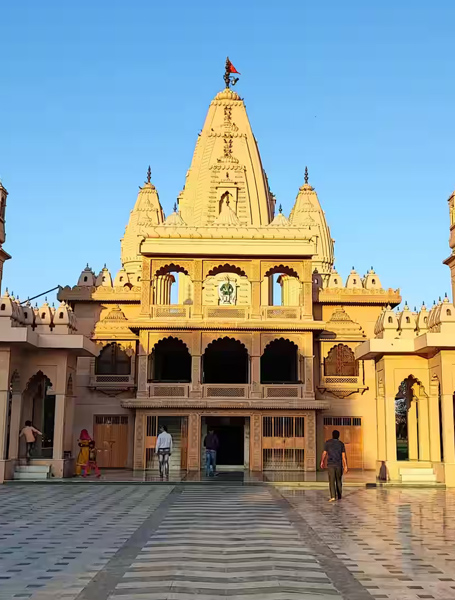
Shree Baldau ji Temple (GARB GRAH)
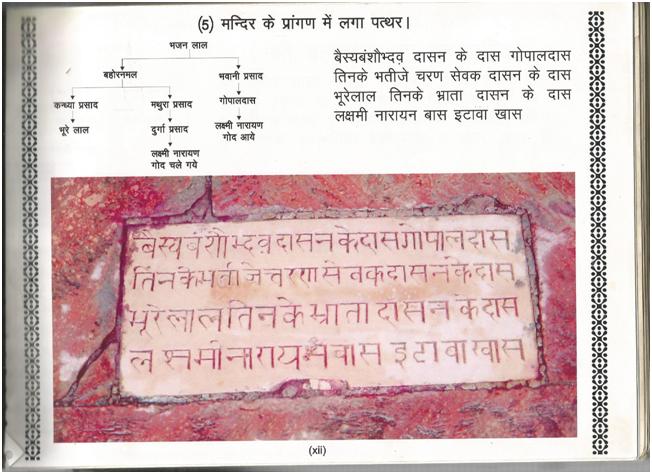
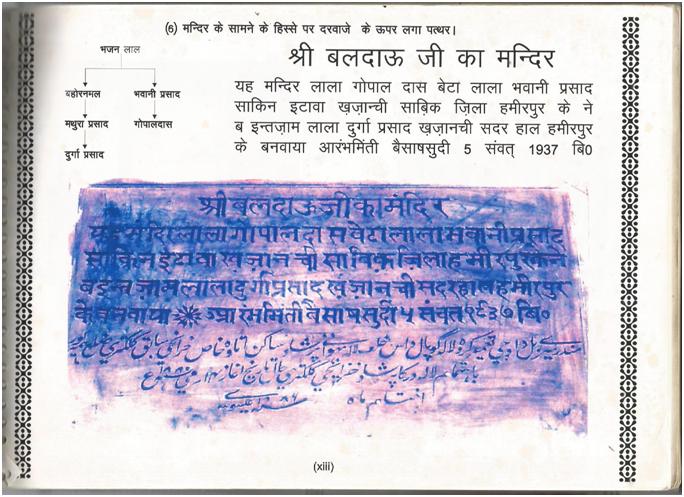
Sri Bhawani Prasad Ji Son of Shri Bhajan Lal Ji had one son –Shri Gopal Das Ji. Sri Gopal Das Ji had no descenders, so he adopted Sri Laxmi Narain Ji, son of his nephew Durga Prasad Ji.
Sri Gopal Das Ji migrated from Etawah to Hamirpur, where he purchased Jamindari in 3 villages of Hamirpur and constructed a temple of Sri Baldauji in the year 1880.
At that time the family was a very close nit when Sri Bhoorey Lal Ji, Sri Durga Prasad Ji and Sri Gopal Das Ji all were very close to each other.
Thus the temple of ‘Shri Baldauji Maharaj’ founded after migrating to Hamirpur from Etawah – also mark the birth of a son to Laxmi Narayan’ named Dau Dayal after the deity of the temple.
The main part of the temple comprising of “Garbhagrah” housing Balram, the elder brother (Dauji) of lord Krishna and also an incarnation of Aditatva (elemental nature) and Sankarashan, Anantnaag, and one of three Ram’s of Sanatan scriptures – Ram, son of Dashrath – king of Ayodhaya, Parsuram, the great angry incarnation of Vishnu and Balram and his wife Revati and younger brother Lord Krishna. It is said the founder wanted to put ‘Radha Rani’, But every time they tried, the statue always felt down refusing to sit with her consort- before her jeth – her consorts elder brother. With the passage of time and due lack of upkeep – the temple deteriorated in condition.
It has a ‘Shivalaya’ also with five statues, Shiv Linga and Nandi. In 2009 temple of ‘Maa Durga Ji’ has also been added to the main temple.
Some light is thrown by the 2 stone planks of the temple which are as follows: